
There’s a new workplace phrase making the rounds – and it’s eerily accurate. It’s one of those terms that makes you pause because it puts words perhaps what you’ve been feeling:
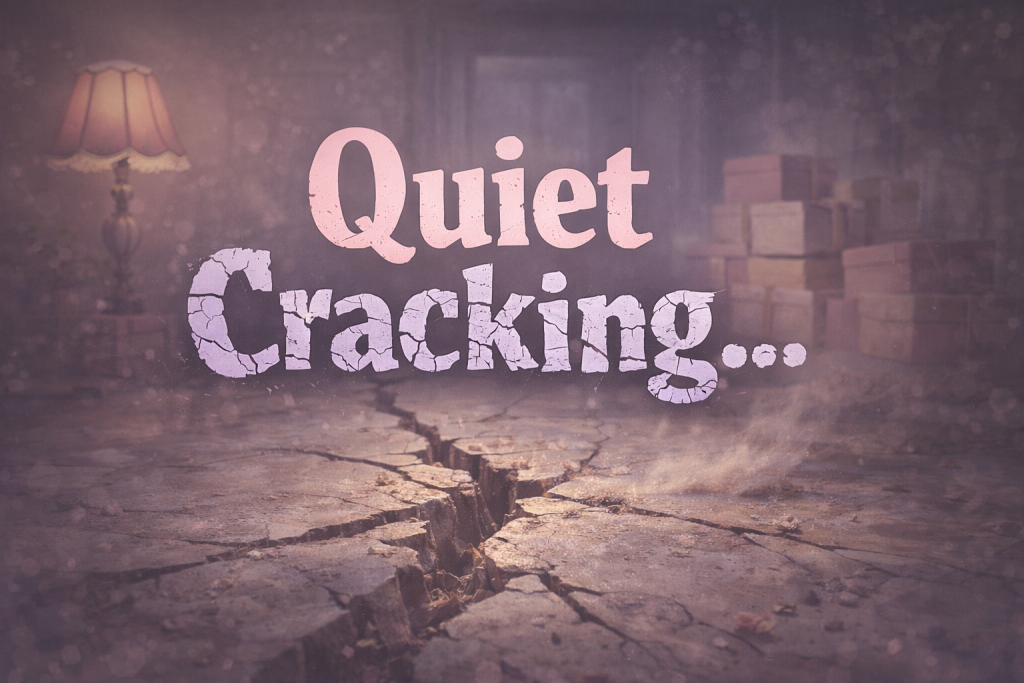
Quiet Cracking
Because maybe you’re still showing up.
Still delivering.
Still answering the Slack message with “Sure!” and a smiley face.
But inside?
You’re tired in a way sleep doesn’t fix.
You’re irritable in a way that surprises you.
And you’re starting to wonder… Is this it? Is this what my life is now?
If that’s you, you’re not dramatic.
You’re not “bad at stress.”
And you’re definitely not alone.
So… what is quiet cracking?
Quiet cracking is basically the slow, invisible slide into dissatisfaction and disengagement – where you look okay on the outside, but your motivation, joy, and energy are quietly draining on the inside.
Not a meltdown.
Not a breakdown.
More like… a leak.
You’re functioning, but you’re fraying.
And because you’re capable, people assume you’re fine.
Hey, sometimes you assume you’re fine.
Until one day you realize:
You’re doing a lot… but you don’t feel like you anymore.

Quiet cracking is NOT quiet quitting (and that matters)
Let’s clear this up, because the internet loves to toss workplace phrases around like confetti.
Quiet quitting is usually described as someone who intentionally pulls back – doing what the job requires– no more, no less. It’s a boundary move.
Quiet cracking is different.
Quiet cracking isn’t about someone setting boundaries.
It’s about someone slowly losing their spark.
It’s the high-performer who wants to care… but can’t find the fuel.
It’s the person who’s still trying… but their nervous system is tapped out.
It’s the “I’m fine!” friend who is one more calendar invite away from wanting to disappear into the woods and raise goats.
(And honestly? I support the goat plan, but we can do better.)
So what are the actual signs you might be quietly cracking?
Here’s how it tends to show up – not with fireworks, but with tiny flags:
- You dread things you used to handle easily.
Emails. Meetings. Basic tasks. Suddenly everything feels heavier. - You feel emotionally “flat.”
Not sad. Not angry. Just… muted. Like someone turned down the saturation on your life. - You’re more reactive.
The smallest things annoy you. You snap. You feel guilty. Repeat. - You’re making more mistakes — or avoiding everything.
Your brain isn’t broken. It’s overloaded. - You’re quietly fantasizing about quitting.
Not because you’re lazy — because you’re exhausted and craving relief.
If you’re nodding along like, “Okay rude, why is this so accurate?” – stay with me.
Why quiet cracking happens (the real reason)
Quiet cracking isn’t a personal failure.
It’s often a systems issue.
It happens when:
- the workload is relentless and “normal” becomes unsustainable
- you’re constantly on, constantly available, constantly responsible
- you’re carrying too many decisions, too much emotional labor, too many invisible tasks
- there’s not enough recovery built into your week
- the reward (growth, support, meaning, recognition) doesn’t match the output
In other words: you’re operating at a pace your body and mind were never designed to sustain.
And if you’re a high-functioning woman who’s used to pushing through?
You’ll keep going… right up until you can’t.
That’s why I always say: self-care alone can’t fix a life that has no structure.
You don’t just need a bubble bath.
You need a better operating rhythm.
The 10-minute “anti-crack” reset you can do this week
Let’s make this real and doable. No life overhaul. No new personality. Just one small shift that creates leverage.
Here’s your 10-minute reset:
Step 1: Pick ONE boundary for the week.
Not ten. One.
Example: “No work texts after 7pm.”
Or: “I’m taking a real lunch on Tuesday and Thursday.”
Or: “I’m not saying yes in the moment – I’ll reply after I check my calendar.”

Step 2: Remove ONE recurring decision point.
Decision fatigue is sneaky.
Choose one thing and simplify it:
• same breakfast Mon–Fri
• two rotating “default” outfits
• a template response for common requests
• one admin block instead of 47 micro-tasks all day
Step 3: Add ONE recovery anchor.
Not “work out six days a week.”
Recovery.
A 12-minute walk. A stretch. A phone-free tea. A night routine that actually calms you down.
Do this for 7 days and watch what shifts: your patience, your focus, your mood, your capacity.
Small changes restore power. And it’s how we sustain the life we want, long term.
If you’re quietly cracking right now, here’s the truth…
You don’t need to wait until you’re fully burnt out to deserve support.
Quiet cracking is your signal… your system is asking for a redesign.
And the goal isn’t to become someone who can “handle more.”
The goal is to become someone who can feel better while doing what matters.
Because success shouldn’t require you to run yourself into the ground.
You don’t need a new life.
You need a better structure.
A clearer week.
Fewer decisions.
More breathing room.
And yes – maybe still the goats. But on your terms.

P.S. 3 resources for you right now…
Busy to Bliss (Online Self-Paced Course)
If you’re quietly cracking because your week has zero breathing room, this is your reset button. It helps you redesign your weeks into an anti-burnout, anti–quiet cracking rhythm—with structure that actually sticks.
It’s currently the lowest price it’s ever been. Visit BusyToBliss.com.

Full Life Redesign (Private Coaching)
If you’re ready for real change—your schedule, boundaries, mental load, and direction—let’s explore what a full life + career redesign could look like for you.
Book your free 30-minute strategy session.
Reset & Thrive Retreat (Fall)
If what you really need is something on the calendar to look forward to, this is that. A powerful reset so you can step out of survival mode and come back to yourself—and have it waiting for you this fall. Reserve your room.